

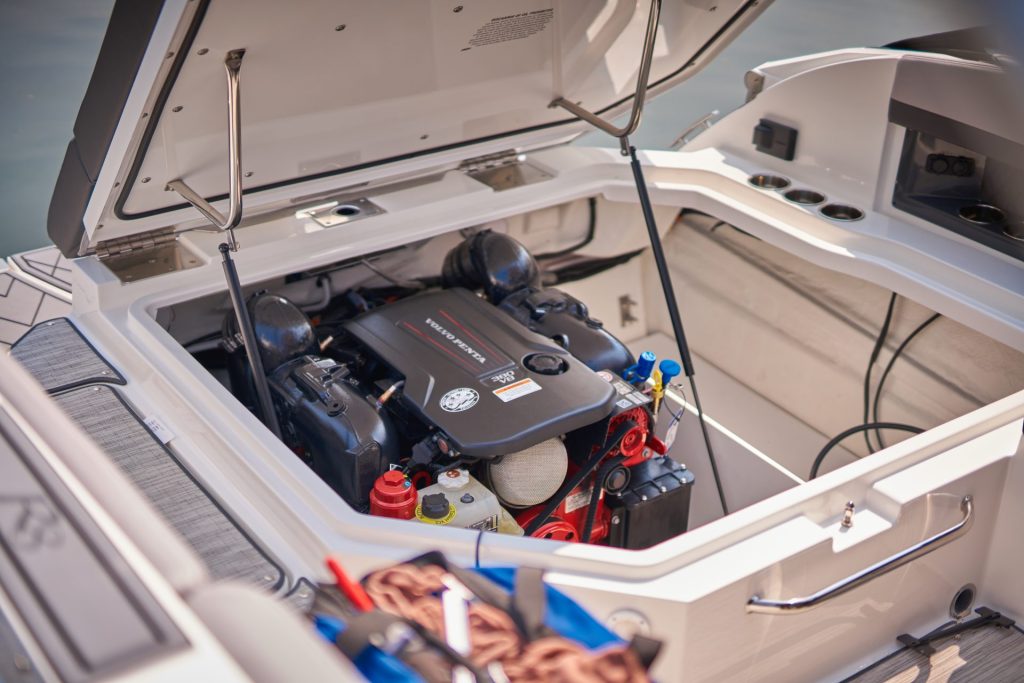
One of the less thought about and, frankly, less fun parts about buying a boat is figuring out your insurance. In the wake of the excitement of getting on the water, it often becomes a rushed afterthought. Most people just want to sign on and move forward so that they can start enjoying their boats. But over the years, I’ve seen the insurance landscape change, and I want boaters to be aware of the things to look out for when shopping for insurance for your boat.
Earlier this year, we had a customer who struck a submerged object, which damaged their props and bent their prop shafts. When the prop shafts are bent, they spin in an ovular pattern instead of a perfect circle. This puts wear on all of the seals and bearings in the outdrive, allowing them to open up, which allows water to get inside of the drive. We test this with a dial indicator that measures the severity of the bends as the shaft is spun by hand. This is a fairly common occurrence, even with very experienced boaters, and we perform more than a few dozen repairs like this each year.
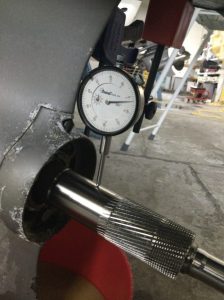 A dial indicator is used to check the amount of bend in a propshaft. In this specific instance, the dial is indicating a bend of 3 thousandths – just outside of the manufacturer’s recommended spec.
The two options at that point are to replace the entire lower, or remove the prop shafts and all the associated bearings, seals, and hardware, and replace them. The overall cost of these two repairs are very similar. Rebuilding reuses more existing parts, but takes significantly longer to complete. Swapping the lower for a full replacement takes only an hour – but comes with a much higher parts cost.
We typically elect to go with replacing the whole lower instead of rebuilding it. There are two reasons for this. First and foremost, all Volvo Penta genuine parts installed by a certified Volvo dealer come with a 2 year warranty at no extra charge. So purchasing an entire lower rather than rebuilding it adds warranty value to the repair. Second, it’s a massive time saver and gets the customer back on the water faster.
If you hand an insurance company an estimate for these two different repairs, with the prices of each being equal, you would think it doesn’t matter to them – do what’s best for our mutual customer, right?
Unfortunately, that’s not how it works. When you sign up for a policy, you can choose between two options in the event of a total loss – agreed upon value, or actual cash value. Agreed upon value is the figure you’d like to expect your insurance company to pay out in the event of a total loss. This means that you can guarantee that if you paid $100,000 for your boat, you’ll get paid out $100,000 in the event of a total loss.
Actual cash value will lower your monthly rate – but you won’t be reimbursed for the full price of a NEW replacement. Instead, the estimated value of your boat at that point in time is what they owe you.
This isn’t a new concept. But what is relatively new in concept is that they’re also now trickling that down into the cost of mechanical repairs. This means that if you sign up for a policy set to actual cash value, they may not be required to pay 100% of the parts cost of your repair. They are only obligated to pay the depreciated value of those parts.
If you need a part that costs $12,000, and they determine your boat has depreciated by 35% since the boat was purchased, they’re only going to pay you $7,800 for that part – AFTER your deductible.
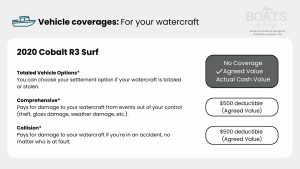
Here’s a screen shot from an unnamed insurance company who offers agreed value vs ACV for totaled, comprehensive, and collision coverage.
Unfortunately, from my experience, I’d estimate that more than 40% of boaters who have accidents which require filing an insurance claim are unaware that they’ve agreed to this with their policies.
My advice to all boaters would be to work with an insurance brokerage rather than going supplier-direct, raise these concerns, and bind a policy that takes all of these concerns into account. Accidents happen to everyone – even the most experienced boaters. Don’t let them be worse than they need to be.
Written by: Adam Pensel, General Manager
✉️ Email: [email protected]